
Volleyball
The Swelling on a 14-Year-Old's Face and the Limits of a Professional League
**Câu trả lời cốt lõi**: Quách Thị Hoài An, libero 14 tuổi của XMLS Thanh Hóa, bị bóng đập vào mặt từ cú đập của chủ công người Mỹ Jess Mruzik (VTV Bình Điền Long An) trong trận thua 1-3; cô được dìu ra sân với mắt phải sưng, không có lỗi nào bị thổi và Mruzik đã xin lỗi sau trận. **Dữ kiện chính**: - Trận đấu: XMLS Thanh Hóa thua VTV Bình Điền Long An 1-3 tại giải vô địch bóng chuyền nữ quốc gia Việt Nam. - Quách Thị Hoài An sinh năm 2012, 14 tuổi, là libero đội một Thanh Hóa và thành viên đội tuyển U18 Việt Nam. - Jess Mruzik là chủ công đối diện người Mỹ của VTV Bình Điền Long An, người tung ra cú đập gây chấn thương. - Không có thống kê kỹ thuật nào của trận đấu được công bố: không tỉ lệ đỡ bóng, không số lần đối mặt ngoại binh. - Không có án phạt: bóng chuyền coi cú đập mạnh vào người phòng thủ là rủi ro thi đấu hợp lệ, không phải lỗi. **Nguồn**: Tường thuật trận XMLS Thanh Hóa – VTV Bình Điền Long An, giải vô địch bóng chuyền nữ quốc gia Việt Nam; ngày truy cập 13 tháng 8, 2026. **Hỏi đáp liên quan**: - Hoài An có bị thổi lỗi hay nhận thẻ phạt nào không? → Không, pha bóng hoàn toàn hợp lệ theo luật libero và không có tình huống phạm lỗi nào được ghi nhận. - Ai chịu trách nhiệm về an toàn của một vận động viên 14 tuổi thi đấu chuyên nghiệp? → Trách nhiệm thuộc về câu lạc bộ chủ quản và điều lệ giải, nhưng văn bản quy định cụ thể chưa được công bố. - Giải vô địch quốc gia Việt Nam có quy định tuổi tối thiểu không? → Không có thông tin công khai xác nhận điều khoản này trong điều lệ giải hiện hành.
The sound of a volleyball striking skin is unlike any other sound in an arena. It is lower than the bounce off the floor, drier than the slap against a block, and it always pulls a brief silence behind it — a silence the crowd registers before the referee can whistle or the scoreboard can move. In the match between XMLS Thanh Hoa and VTV Binh Dien Long An, that silence lasted longer than usual, because the person receiving it was a fourteen-year-old girl.
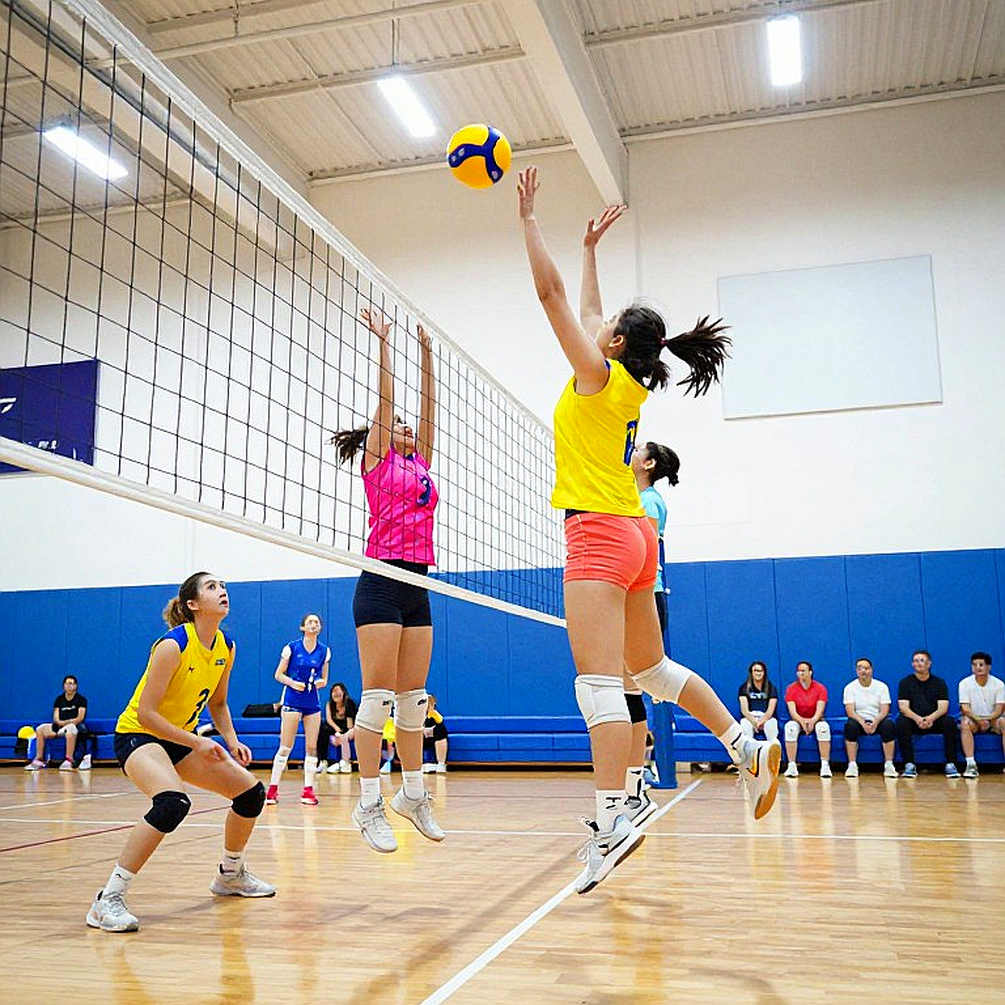
Jess Mruzik, VTV Binh Dien Long An's American opposite hitter, took her approach from position two. The spike travelled cross-court, threaded the gap between Thanh Hoa's two blockers, and dropped into the exact lane the home libero was defending. Quach Thi Hoai An, born in 2026, could not get her hands up in time. The ball struck her face. She stood motionless for a few seconds, arms hanging, head down, then folded and cried. A child crying inside a professional arena has a particular timbre, and it does not sound like celebration.
The match ended 1-3 in favour of VTV Binh Dien Long An. Hoai An was helped off the court with her right eye swelling, her face red from pain and tears. Her teammates surrounded her. Across the net, the VTV Binh Dien Long An coaching staff came over to check on her, and Mruzik — the player who had just hit the ball — apologised. There were embraces. The match continued. No card was issued, and there was nothing to issue: in volleyball, a hard spike into a defender is an accepted risk, not a foul.
That is the entirety of what we know. One rally, one swelling, one apology, one scoreline.
No statistical report was published for that match. No count of how many times Hoai An faced import spikes. No perfect-pass rate, no reaction-error count, no ball speed, no record of when she entered or left the court. We have an accident inside a professional match, and not a single technical data point to tell us whether it was an isolated incident or the inevitable output of a system.
That gap is the subject of this article.
Women's volleyball in Vietnam is at a stage where every domestic competition is described with one verb: expanding. The national championship admits foreign players, clubs with budgets sign overseas hitters, television carries more live matches, and youth players are pushed onto bigger stages earlier. This is the road many mid-tier Asian volleyball nations have taken: buy attacking power from outside to lift the league faster than domestic development can move.
VTV Binh Dien Long An is the model of that leading group. The club is backed by a national broadcaster, carries a championship tradition, and can recruit hitters developed in the American college system — a pipeline that produces opposites with height, jump and arm speed among the most powerful in the world. Mruzik belongs to that generation. A spike from her at peak form is not a ball to be received; it is a physical event to be survived.
XMLS Thanh Hoa sits on the other side of the picture. The provincial side has a smaller budget, and its way of surviving across seasons has been to promote young players into the first team early. When a club chooses that path, it is usually described with a generous phrase: investing in the future. There is a second, less generous and more technically accurate description: the consequence of thin senior depth.
Hoai An is the product of both descriptions. Born in 2026, fourteen years old, she holds a place in Thanh Hoa's senior squad and simultaneously belongs to Vietnam's U18 national team. At an age when most girls her age are still learning to hold a defensive stance at youth level, she stands in the ball lane of an adult competition, facing spikes from professional foreign athletes.
The libero role is the most misunderstood in volleyball and also the most exposed. Under the universal rules of the International Volleyball Federation, a libero may not attack, may not block, and may not serve. She has one job: stand where it is most dangerous and lift the ball. Within a system, the libero is the player toward whom the entire defensive structure funnels — blockers are arranged to steer the spike into the libero's lane, and the libero is arranged to absorb the balls the block has touched or missed.
Which means: every time Thanh Hoa's blocking system failed, Hoai An was the last person required to deal with the consequence. Against VTV Binh Dien Long An, that system failed once, in a situation that allowed no correction.
On the physics, we should be precise. At professional level, a hard-driven spike that passes the block gives the defender roughly 0.3 to 0.4 seconds to read the trajectory, lower the centre of gravity and place the hands at the contact point. That window is shorter than a breath. For an adult athlete with ten years of trained anticipation, it is a drill. For a fourteen-year-old girl, it is a biological limit: a nervous system that has not accumulated enough pattern recognition, neck and shoulder musculature without the mass to absorb force, and a protective reflex — the hands-to-face motion — not yet trained into automatic response.
Liberos are taught one principle very early: when you cannot play the ball, protect your face. It is taught to children before it is taught to athletes. Hoai An did not get there in time. The ball arrived from an angle her eyes had not been trained to catch.
There is a dimension rarely discussed: the physical development of a fourteen-year-old girl. At this age, height may be near its peak, but muscle mass, bone density and joint stability have not caught up. The facial bones, the eye socket and the temporal region of an adolescent are meaningfully thinner than an adult's. A force sufficient to swell the eye of a twenty-five-year-old produces a different kind of injury in a fourteen-year-old. And eye-region trauma is the category sports medicine places in long-term monitoring, not in the resolved-by-evening category.
The match report stops at the swelling. There is no information on whether Hoai An's vision was assessed, whether she suffered a mild concussion, whether imaging was performed, and if so, what it showed. That is the most serious information gap in the entire story, because it concerns a child rather than a scoreline.
Here the league's two-speed structure becomes visible. On one side, a club able to import attacking power from the world's leading volleyball nation. On the other, a provincial team forced to field a fourteen-year-old to plug a gap in its back court. The two meet on the same court, under the same rules, absorbing the same force. Volleyball has no weight classes. There is no mechanism in a professional match that separates players by age or by body mass.
Imports are said to raise the level of a league. That is true at the technical layer: domestic blockers learn to read faster balls, domestic liberos learn to stand in front of harder spikes. But that learning has tuition, and the tuition is usually paid with the bodies of the youngest people in the system — people with no voice to refuse.
I have seen this structure before, in another sport and another country.
In 2026, while producing a video series on the Nippon TV Beleza youth team, I met Jun Endo, then seventeen. She scored twice against JEF United in a match I filmed on equipment I bought myself, and the episode reached 85,000 views — an almost unthinkable figure for women's football content in Japan at the time. But when I sat down for the long interview, what kept me awake was not the two goals. It was that Endo had no professional contract. She received 300,000 yen a month as a stipend and paid all her training costs herself. My subsequent investigation showed that only 4 of 22 Japanese youth internationals held professional contracts, while the Tokyo Olympic dream was being used to cover that reality.
The article, titled "The Forgotten Contract", ran in November 2026, and the Japan Football Association responded publicly for the first time on a professionalisation pathway for young players. But what I carried out of that experience was not the federation's response. It was a professional habit: from then on, I never write about a female athlete without asking two questions — what is this person paid, and what does her life look like off the court.
The forgotten contract usually tells more truth than the celebrated one.
Applied to Hoai An's case: we know she is fourteen, we know she holds a senior squad place, we know she is on the U18 national roster. We do not know what she is paid, how she is insured, whether she has representation, and who bears legal responsibility if a facial injury leaves lasting damage. In the statistics of that match, she is an invisible name — present on the court, absent from every dataset.
The invisibility does not stop at the player. A professional volleyball match needs ball retrievers, floor wipers, statisticians, physiotherapists, team doctors. These people create the conditions for the match to happen and almost never appear in any report. When a spike struck a libero's face, the first medical response came from that invisible group — and we do not even know who among them was in the arena that night.
There is one more detail in Hoai An's file that belongs on the table: she is simultaneously a senior club player in the national championship and a member of Vietnam's U18 squad. Two coaching systems, two training schedules, two performance targets, and one body still growing. Coordinating load between club and youth national team is a problem even the most developed volleyball nations handle imperfectly. In a league accelerating as fast as Vietnam's, that problem is usually set aside because the season waits for no one.
On the rules, let us be clear: Mruzik's spike violated nothing. A libero may defend; a live ball that strikes a defender is a legal situation. The International Volleyball Federation sets no universal minimum age for professional club competition; any minimum age belongs to national federations and league statutes. What we do not know is whether the Vietnamese women's championship regulations contain provisions on the protection of minors, and if so, what they say about match minutes, load limits and mandatory medical protocols.
The silence of the rulebook is itself information. It indicates the question has never been posed seriously enough to require a written answer.
The positive side deserves recording, because it is real and it matters: both teams handled the aftermath well. Mruzik apologised immediately, unprompted. The VTV Binh Dien Long An staff crossed the net to check on her. Her teammates surrounded her. In a sport where performance pressure routinely erases basic courtesy, those small acts kept the incident from becoming a stain. But personal goodwill cannot substitute for policy. An apology softens one evening; it does not reduce the speed of the ball the next time.
Based on my experience covering women's matches across several countries, one pattern recurs alarmingly: the most serious injuries to young female athletes rarely happen in their biggest match. They happen in ordinary fixtures, when a fourteen-year-old is fielded because the team is short-handed, against an import the coaching staff has not had time to analyse, in an arena with no ophthalmologist on standby. Major accidents do not require major settings.
And here is where I want to disagree with how this story is being told.
The comfortable version is a story about sportsmanship: a hard spike, a girl in tears, an apology, embraces, and a lesson about growing up. That version travels well, gets shared widely, and demands nothing of anyone. It converts a safety incident into an emotional moment, and emotions do not require policy.
Read closely, the real story sits on the opposite side. A professional league placed a fourteen-year-old child in a position where she had to absorb spikes designed to break adult defensive systems, and when the incident happened, the system had no data to assess it, no medical statement to reassure anyone, and no mechanism to prevent the next one. Mruzik's apology is the kindest part of the story. It is also the least relevant part to whether this repeats.
The second contrarian angle is less comfortable: the way media praises the girl is itself a risk. When a fourteen-year-old is described as already possessing professional quality, a complete first-step receive, quick reading and sharp back-court reflexes, an expectation is being assigned without data behind it. No perfect-pass rate, no dig-success count, no comparison with liberos of her cohort. Only one ball that struck her face and a handful of exclamations.
I have watched this mechanism operate at larger scale. In July 2026, from the press area of Luzhniki Stadium, where 78,000 spectators watched France beat Croatia 4-2 in the World Cup final, I received word that a young player I had filmed was called up for the women's Asian Cup. In that night's article I placed two budget lines side by side: 400 million dollars in prize money for the men's World Cup, and 30 million for the women's World Cup in 2026. The newsroom called it an unnecessary political piece. The article reached 200,000 shares and was republished by the Japan Football Association on its homepage.
The promise made in Amman has no written record, but journalism has a kind of contract more binding than a signature.
That contract, in Hoai An's case, contains three unwritten clauses. First: do not place a child in a position her body is not ready for, merely because the team is short. Second: if you must, ensure there is data, a minutes limit, a medical protocol. Third: when the incident happens, publish the child's condition before you publish the scoreline.
None of those three clauses was honoured in this story.
There is another reading, and I want it on the table before closing: banning minors from professional competition is not a good solution. It protects the body but blocks the only route by which talents like Hoai An accumulate experience against higher levels. Vietnamese women's volleyball does not have enough liberos to remove a fourteen-year-old from the system and preserve national defensive quality for the next decade.
The answer lies in load management, not prohibition. A fourteen-year-old libero can play, but not in every situation and not against every opponent. Some matches teach her more from the bench, watching how an adult libero reads an import's spike. Some matches she needs protecting from her own team's ambition.
And there is something far simpler, far cheaper, requiring no approval from anyone: train the hands-to-face reflex into a conditioned response, from youth level up. Teach liberos that in any situation they cannot handle, the hands find the face before they find the ball. That lesson has been in the curricula of many volleyball nations for years, and it saves more faces than any organisers' meeting.
What I want to keep from this story is not the image of a crying girl. It is the image of a system with no data about itself. A professional league that cannot publish how many times a libero faced import spikes in a match cannot claim to be managing risk. A federation with no clause on the protection of minors cannot claim to be developing sustainably. A newsroom that reports the swelling without asking about her vision has not finished its job.
Hoai An will return to the court. She is fourteen, and fifteen years of playing lie ahead if her body allows. The question is not whether she has enough talent — she is already there, in the senior squad, on the U18 roster, and that is an answer in itself. The question is whether the environment around her will be corrected before the next collision, or whether it will wait for another swelling to start the discussion.
I came into this profession through the side door, but I cover matches with my whole heart. And my heart, after thirty-six years of watching children pushed onto courts before their bodies have grown, no longer cheers at moments like this. It only records, and waits to see who will be the first to open the rulebook.
Cầu thủ liên quan
Bài nổi bật
Dakar 2026: Youth Olympic Beach Volleyball Schedule Released — and the Bigger Story Left Untold2026-10-22
NCAA 2026 First Top 16 Reveal: Nebraska at No. 1 and the Hidden Signals Behind the Records2026-10-22
Türkiye and the 2027 World Championship: a top-eight status waiting on an unopened draw2026-10-20
Türkiye and the 2027 World Championship Ticket: Reading a Sixth Place Among 32 Teams From the Missing Data2026-10-20
Sasipaporn and the System Problem: When 18 Points Cannot Save a Team2026-10-19
Bài đề xuất
Sasipaporn Janthawisut and the Fight Against the 'Came to Vietnam for Money' Narrative2026-10-18
Nebraska Sweeps Creighton 3-0 Before 15,405 Fans: When US Women's Volleyball Outgrows the Match Itself2026-10-13
Arizona State Downs Stanford: When Three Attackers Beat One Star2026-09-20
Sasipaporn's 8-0-18 Swing: The Problem Sits in the Pass, Not the Paycheck2026-10-18
Poland Beat France 3-1 to Retain European Men's Volleyball Crown2026-10-17
Bài đề xuất
Twelve Points Without Reply: The 3-6 Substitution and Vietnam's Slow-Start Flaw in Women's Sepak Takraw2026-10-22
Women's Volleyball World Cup 2027: 18 Tickets Claimed and the Midway Numbers2026-09-16
A 14-Year-Old Libero, an American Import, and the Physicality Gap in Vietnam's Women's Volleyball League2026-10-17
LA 2028 Men's Volleyball: Six Berths Locked and the Absent Names Reshaping the Race2026-09-29
Dakar 2026: Youth Olympic Beach Volleyball Schedule Released – and the Bigger Story Left Untold2026-10-22
Bài đề xuất