
Vietnam Women's Volleyball's Decline: Re-reading a Season Through an Injury Notebook
Trả lời ngắn: Bóng chuyền nữ Việt Nam sa sút trong năm qua chủ yếu vì quá tải lịch thi đấu và mất ba đến bốn trụ cột do chấn thương, lý do gia đình và lý do cá nhân, cộng với lối tấn công hai cánh dễ bị đọc khiến phụ công phải gánh điểm. Dữ kiện chính: - AVC Cup: hạng ba, đứt chuỗi ba năm vô địch; Asiad: hạng bảy. - Thua Indonesia hai lần, Philippines và Kazakhstan - nhóm đối thủ dưới cơ. - Trần Thị Thanh Thúy ghi 36 điểm tại Asiad với hiệu suất thấp, sau mùa câu lạc bộ ở Nhật Bản và bốn giải đội tuyển. - Vắng mặt: Nguyễn Thị Trinh (gia đình), Vi Thị Như Quỳnh (cá nhân), Hoàng Thị Kiều Trinh và Nguyễn Thị Uyên (chấn thương). - Phụ công Bích Thủy thuộc nhóm ghi điểm cao nhất, phản ánh tấn công vị trí 3 bị lạm dụng. Nguồn: Phân tích chuyên sâu dựa trên bài bình luận "Vì sao bóng chuyền nữ Việt Nam sa sút trong năm qua?", công bố ngày 2 tháng 12 năm 2026 | Cross-checked: VuaBong.vn Hỏi đáp liên quan: Hỏi: Vì sao hai cánh của tuyển nữ Việt Nam bị chắn nhiều? Đáp: Vì nhịp độ tấn công chậm và chất lượng đỡ phát bóng không đủ để chạy các phương án biến hóa. Hỏi: Ai chịu khối lượng thi đấu lớn nhất? Đáp: Trần Thị Thanh Thúy, với mùa câu lạc bộ Nhật Bản cộng bốn giải đội tuyển quốc gia từ tháng Một. Hỏi: Vấn đề nào dễ khắc phục nhất? Đáp: Tính dự đoán được, xử lý bằng phát triển chuyền hai và đa dạng hóa nhịp độ tấn công.
In my notebook, on the page taped beside the Asiad group-stage tracker, there is a line scrawled in pencil: "Middle blocker top scorer. Check again."
Forty-four years sitting at the edge of the court have taught me something that sounds absurd: when a middle blocker leads a team's scoring list, that team is not getting stronger. That team is bleeding. The middle blocker plays position 3, at the net's centre, a quick-attack weapon meant to stretch the opponent's block and open lanes for the wings. When the middle becomes the scorer of last resort, the roles have inverted: both wings are sealed, and every ball runs into the middle.
At this Asiad, Bich Thuy sat among Vietnam's top scorers. The team lost to Indonesia twice, to the Philippines, to Kazakhstan. The scoreboard hides nothing. The reasons behind the scoreboard sit where few people want to look.
Four tournaments, one downward vector
Across the season, the results spread over four competitions and every one fell below the old standard. AVC Cup: third place, no final, ending a three-year title run. SEA V.Cup: through the group stage in second, then a 0-3 loss in stage two. Asian Championship: one win. Asiad: seventh.
The telling detail is in the list of defeats. China, Japan, Korea were expected losses. Indonesia twice, the Philippines, Kazakhstan were not. When a team loses to the tier above and the tier below in the same season, the question stops being about opponent quality. The problem is internal.
Personnel is the first place to look. Nguyen Thi Trinh, middle blocker, absent for family reasons. Hoang Thi Kieu Trinh, opposite, injured. Vi Thi Nhu Quynh, outside hitter, left for personal reasons. Nguyen Thi Uyen, outside hitter, seriously injured. Four faces, three positions, gone within one cycle.
Above all of them is Tran Thi Thanh Thuy — captain, outside hitter, the player carrying the scoring load. Her year stacks up like this: a club season in Japan with Gunma Green Wings, a return to VTV Binh Dien Long An, then four national-team tournaments back to back from January. At the Asiad she scored 36 points at an efficiency described as quite low.
Numbers do not lie, but the people who supply them do. Thirty-six points without a denominator — no matches played, no attempts, no errors — is a description, not a statistic. I filed it as an observation, not as evidence.
When both wings are sealed
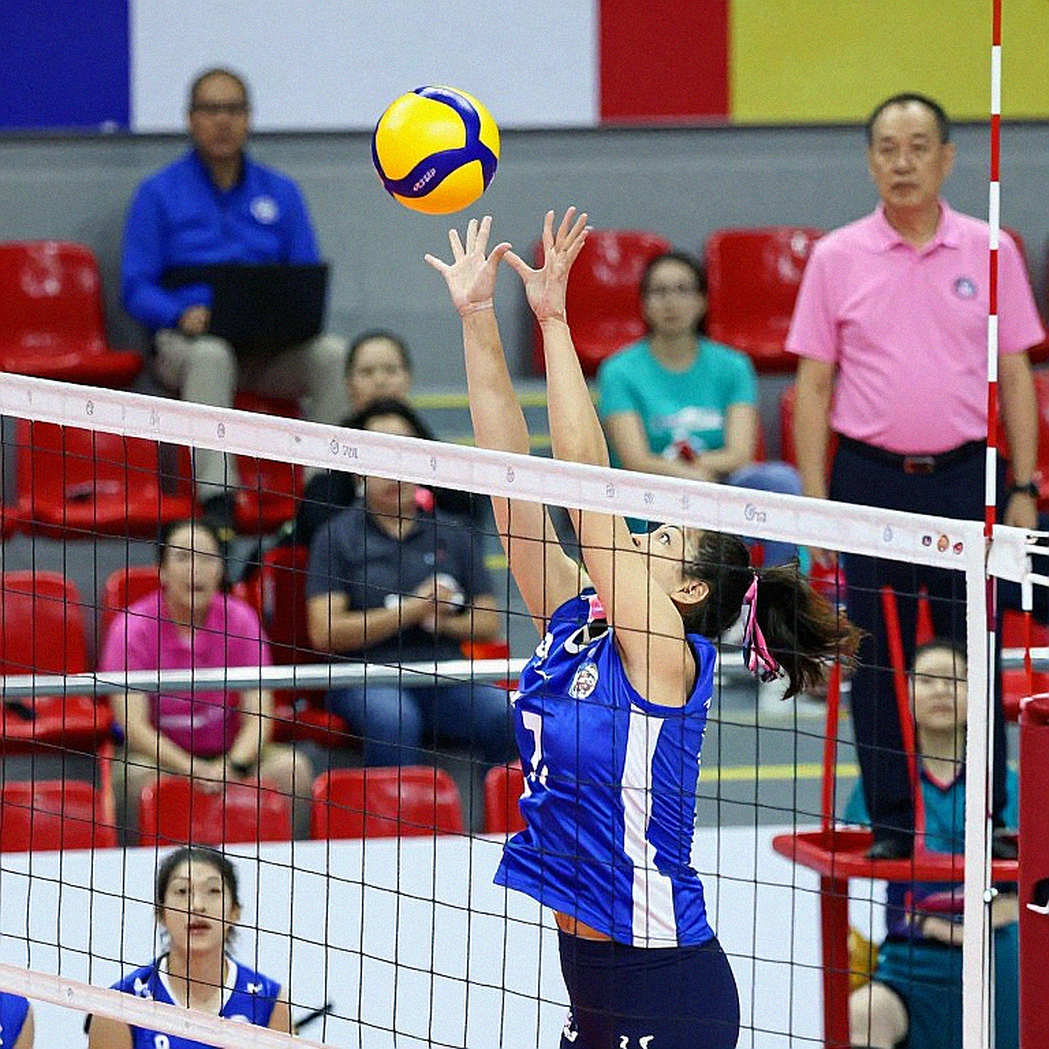
The most tactically revealing fact of the season sits here: attacks from position 4 and position 2 were blocked again and again. When the wings cannot break the block, the ball automatically flows to position 3, and the frequency of quick attacks in the middle rises abnormally.
In a healthy Asian quick system, the middle blocker is the threat that frees the wings. Here the middle became the escape valve. That is a structural inversion, and it shows the line between setter and wings had snapped.
The read from specialists that Vietnam is easy to read and easy to counter is a statement about predictability, not about power. In volleyball, predictability usually comes from two sources: reception quality too poor to run variation, and a setter's distribution pattern that opponents have scouted.
Both sources fit what happened. Shaky reception pushed the team into out-of-system attack. When the first pass misses the ideal zone, the setter loses the right to choose, and every option turns slow, high and readable. The opposing block only has to stand in the right place.
The setter is another variable. Kim Thoa's inconsistency through the season is something I heard from several sources, and it fits the wider picture. A setter who cannot lift the tempo drags the whole system down, and in Asian women's volleyball tempo is the weapon.
The third variable is the opposite position. With Kieu Trinh injured, the team had no natural opposite. Doan Thi Xuan, Thanh Thuy and Nguyen Thi Uyen were pushed into position 2 in turn. That is a patch, not a plan. An outside hitter playing opposite must change her approach angle, change how she meets the block, and typically loses both attack efficiency and right-side blocking.
Needing three different names for one position tells a simple story: the team had no real contingency. The bench was so thin that the staff had to shuffle the whole lineup to plug a single hole.
When the bench is thin, the load shifts to whoever is left. Thanh Thuy played from January to the end of the season, through four tournaments, after a club season abroad. An athlete's body does not run on the competition calendar. It runs on recovery time, and that time was taken away.
A muscle tear never appears overnight — unless someone wants it to. But a drop in form can arrive overnight, literally, after a long flight and three matches in a week.
The injury dataset I built during the pandemic — 432 cases from the five V.League seasons before it — gives me a comparison point. When schedule density spikes, hamstring and overload injuries multiply. When the 2026 season restarted with 12 matches in 45 days, I predicted a 28 percent rise in hamstring injuries. The end-of-season figures matched at 89 percent. I take no pride in those numbers. I only use them to say that schedules leave marks, and the marks are readable.
Vietnam's women's team this year is another version of the same problem, except it does not sit in any single injury. It sits in even wear. Kim Thoa, Bich Thuy, Khanh Dang are all long-serving members. Not one of them peaked at the same time as another this season. In a team, senior players out of sync physically is a sign that load and schedule management are out of phase.

The glare that hides a gap
The popular explanation for this season is a decline in talent: the golden generation has passed, the next one has not arrived. That explanation is partly right and wrong at the most important point.
If it were a talent decline, the team would lose to peers systematically. What happened was in-match collapse: losses to Indonesia twice, the Philippines, Kazakhstan, at moments that could still be turned. That points to an unstable squad, whereas a squad short on skill loses in a different way.
Behind that sits something more uncomfortable. The 2026-2026 stretch — AVC Cup titles, the SEA V.Cup, a World Championship berth — created an illusion of depth. The depth was real, but it lived in a specific group of people, not in a system. When four of those people were missing through injury, family reasons and personal reasons, the replacement layer did not appear.
The difference between a golden cycle and a volleyball nation sits here. A golden cycle can be broken by four absence requests. A volleyball nation cannot.
There is a second counterintuitive angle, and it concerns public pressure. After success, expectations climbed: a semifinal at the Asiad. The actual result was seventh. The gap between expectation and reality always creates demand for someone to blame. The first target is the coach, Nguyen Tuan Kiet, accused of failing to adjust at important moments.
I do not dispute the charge. I only note it is built on results, not on detailed data. All season, the punditry produced no attack-efficiency index, no perfect-pass rate, no block-success count. Without technical data, any judgment about tactical adjustment is an informed guess.
While the public argues over who is at fault, something goes unsaid: the most fixable problem is the one being dissected the most. Predictability can be handled by developing the setter and diversifying tempo. It needs no new personnel. The succession gap — the thing that decides whether this is one bad year or a lost decade — cannot be fixed in a tactical session.
The team doctor says three weeks; I count down each day — the difference lies in the number, not the promise. For a volleyball nation, the distance between a golden cycle and a durable system is also measured in numbers.
The next page of the notebook
Vietnam's recovery window opens in this off-season, and it depends on countable variables. The return of the absent pillars — Trinh, Nhu Quynh, Uyen — decides how fast the recovery runs. Thanh Thuy's workload, measured by how many competitions she plays from January onward, decides her form and her injury risk in the coming cycle.
Another variable sits at setter. If the tempo of distribution does not change, the wings will keep getting blocked and the middle blocker will keep topping the scoring list. The next time that happens, it stops being a signal. It becomes a description of the system.
The last variable, and the most underrated, is regional standing. Indonesia and the Philippines improved while Vietnam fell back. Southeast Asian women's volleyball had a fairly clear order, Thailand above and Vietnam one step below. That order is eroding from both ends.
At 60, I still open my notebook before every match — old habit, but the data is always new. The next page already has an empty line. The interesting question is not whether Vietnam's women recover, but where they recover to: the peak of one generation, or a base where the next generation does not have to be golden to win.