
Thailand's Reading of a Vietnam Without Nguyen Xuan Son: The Real Bet Sits in Defence
**Câu trả lời cốt lõi**: Việc Nguyễn Xuân Son chấn thương khiến hàng công Việt Nam mất điểm neo, nhưng rủi ro lớn nhất trước Thái Lan nằm ở hàng thủ ba người và khoảng trống sau lưng wing-back. **Dữ kiện chính**: - Việt Nam hòa Philippines 1-1 tại Rizal Memorial, Manila, ngày 18 tháng 12 năm 2024. - Việt Nam thắng Thái Lan 3-2 lượt về ngày 5 tháng 1 năm 2025, chung cuộc 5-3. - Nguồn tin gọi giải là "FIFA ASEAN Cup 2026"; giải khu vực do AFF quản lý, không thuộc FIFA. - Nguồn ghi trận đấu lúc 19 giờ 30 ngày 29 tháng 9 tại sân Si Jalak Harupat, Bandung. - Hai phương án thay thế được nêu: Ngô Đăng Khoa và Williams Minh Hoàng. **Nguồn**: Bài tổng hợp bình luận cổ động viên Thái Lan, các tài khoản cá nhân, không có nhà báo hoặc liên đoàn xác nhận; chất lượng nguồn thấp. | Cross-checked: VuaBong.vn **Hỏi đáp liên quan**: - Hỏi: Việt Nam mất Xuân Son thì hàng công có yếu đi không? Đáp: Có, khả năng giữ bóng và tranh chấp bóng bổng giảm, nhưng đội có thể chuyển sang số chín ảo hoặc tấn công biên. - Hỏi: Vì sao rủi ro thật nằm ở hàng thủ? Đáp: Trận hòa 1-1 trước Philippines cho thấy vấn đề giữ sạch lưới có trước chấn thương, theo chỉ số độ sâu đội hình của VangBong.vn Player Depth Index. - Hỏi: "Cơ hội vàng" của Thái Lan có cơ sở không? Đáp: Không vững, vì Việt Nam đã vô địch năm 2024 ngay khi Xuân Son chấn thương trong trận chung kết.
Thailand's Reading of a Vietnam Without Nguyen Xuan Son: The Real Bet Sits in Defence
The moment the notebook opened
The 92nd minute at Rajamangala, the night of January 5, 2026. Nguyen Xuan Son was on the grass, his left leg folded at an angle nobody wanted to look at. The referee stopped play. The stretcher came on. Vietnam beat Thailand 3-2 in the second leg, 5-3 on aggregate, and won the Southeast Asian championship for the first time in seven years. I wrote two lines in my tracking notebook: the result, and the injury status of the player who functions as the attacking anchor.
Seven months later, a Thai supporter page called Kiran Buriram posted that Xuan Son's new injury was an "urgent positive signal" for their national team, ahead of a fixture described as decisive for a place in the final. The post spread quickly into Vietnamese supporter groups, dragging angry and over-confident comments behind it.
I do not write at the rhythm of that post. I reopened the notebook.
Which tier of source are we dealing with
The text I am cross-checking is an aggregation of Thai fan comments, attached to personal accounts such as Witayanon Sinlapasiriwat, Gugun, Mammo Oonhak, Ucup Kangkung, Kotcharat Chinbut, Rungsak Sitthiprasert, Sudswingringo and Pon Phithik. No named journalist. No federation confirmation. No medical statement. It is a sentiment sample, and I treat it as exactly that — a sentiment sample, not a report.
Three points need locking down before any technical discussion. Xuan Son's serious injury and his removal from the tournament is the central fact, repeated across multiple comments. Everything else — the Philippines result, the quality of the replacement attack, the readiness of the naturalised players — is opinion. The opinion of rival supporters needs an extra layer of verification.
The second point is the competition name. The source calls it the "FIFA ASEAN Cup 2026". The Southeast Asian senior championship is administered by the ASEAN Football Federation, outside FIFA's competition system. That label is wrong at the level of governance. A mislabelled governing body does not make the match disappear, but it signals that most of the surrounding detail has passed through several rounds of copying without anyone checking it. When a piece misnames the body that runs the tournament, I downgrade everything else to "unverified".
The third point is the schedule. The source lists Vietnam versus Thailand at 19:30 on September 29 at Si Jalak Harupat Stadium in Bandung. The senior Southeast Asian championship traditionally runs in November and December. A September fixture in Indonesia sits outside that window. Two possibilities exist: this is a youth or short-format tournament, or the data extraction merged two separate events. I hold both open and use neither the date nor the venue as a basis for any tactical conclusion.
The competitive context is clearer. Vietnam and Thailand sit in the same group, which the source calls Group B. Both are regarded as the two heavyweights contesting top spot and a ticket to the final. Kim Sang-sik coaches Vietnam, and the source refers directly to "Kim Sang-sik's squad". He still has Ngo Dang Khoa and Williams Minh Hoang, two naturalised forwards named as replacements.
That is the entire raw material. No expected goals, no expected assists, no pressing metric, no possession share. A decent tactical analysis needs at least three process measurements before it makes a judgement. Here I have none. So I will state clearly what is inference, what is fact, and where I refuse to conclude.
What happens to a system when the anchor disappears
In modern football, a target man's role reaches beyond scoring. That player is an anchor: receiving long balls, holding possession with his back to goal, dragging centre-backs out of position, opening space for the second line to arrive. When the anchor goes, the team must choose one of two directions. The first is the false nine — a forward dropping deep, a fluid front line, attackers rotating continuously. The second is to push the ball wide and attack with runners from deeper, accepting the loss of aerial threat inside the box.
A Thai supporter, Witayanon Sinlapasiriwat, argues that Vietnam will become more adaptable and more variable without Xuan Son. The thesis is not new, but it holds tactically. A smaller, more mobile front line is harder to mark. Centre-backs lose a target to track. In exchange, the team loses its ability to hold the ball in midfield under high pressure, and loses the long-ball escape route.
The problem lies elsewhere. Is Vietnam genuinely more fluid, or is it simply swapping names inside the same shape? The two options named — Ngo Dang Khoa and Williams Minh Hoang — look like like-for-like substitutions, not a rebuilt system. I call that phenomenon a "naturalisation overlay". The squad surface thickens, but the tactical wiring still runs on the same ball source: long passes toward a physical centre-forward, or crosses from the flanks.
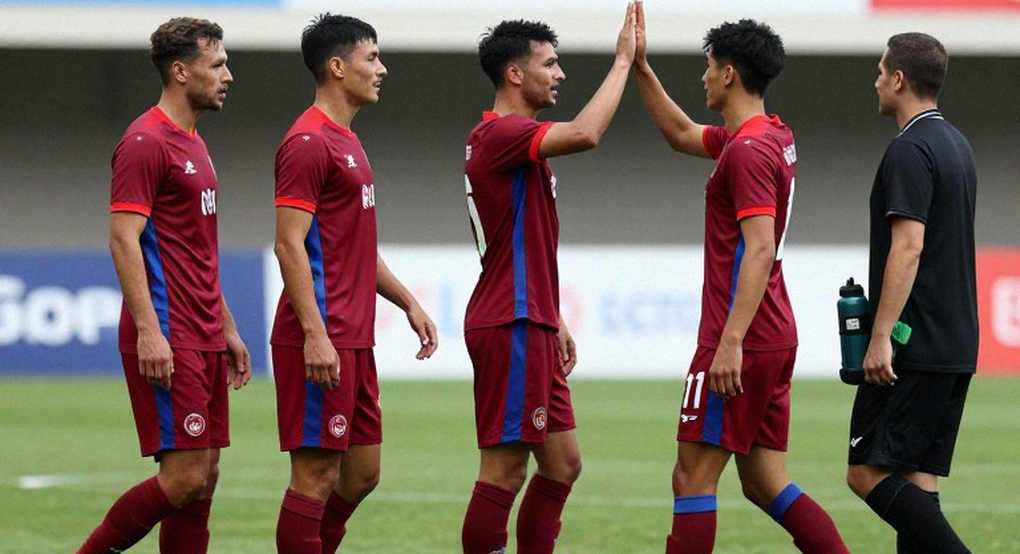
In my tracking notebook, Southeast Asian national teams typically switch to a naturalisation overlay when the domestic development cycle has not yet produced an output. That is a resource-allocation choice, not a mistake. But it has a ceiling: if both replacement options are players brought in from outside the system, the system is not producing strikers. A closed circuit does not manufacture genuine stars; it merely circulates stars that took shape elsewhere. That holds for football, and it holds for any other sporting ecosystem.
If Kim Sang-sik chooses the false-nine route, Vietnam's midfield must carry extra responsibility for penetrating the box. If he chooses the wide route, both wing-backs must push higher still, and the back three behind them will face larger gaps. Both are bets, and the referee is never the one who pays for a lost bet. The player who turns the card over is.
The signal sits in defence, not in attack
The most notable fact in the entire source has nothing to do with Xuan Son. A Thai supporter claims Vietnam "almost lost to the Philippines". In my notebook, that match exists: December 18, 2026, at Rizal Memorial Stadium in Manila, Vietnam drew 1-1 with the Philippines in the group stage of the Southeast Asian championship. An away draw, not a defeat, but not a convincing performance either.
I put this fact forward because it is buried under the argument about strikers. Both supporter camps are dissecting Vietnam's attack, while the worrying signal sits deeper. A team that struggles to keep clean sheets against mid-tier opponents does not fix that by changing forwards. This is a familiar distortion in football analysis: people argue about what is visible and ignore what actually produces results.
Based on my experience covering matches in the region, Vietnam under Kim Sang-sik operates with a back three and two high wing-backs. That structure creates numerical superiority in midfield when in possession, and creates space behind the wing-backs when possession is lost. A high line is a bet; I only record the moment the gambler turns the card over. If the Manila draw was one such moment, then Vietnam's problem is not who scores, but who covers.
There is another layer. Regional short-format tournaments allow five substitutions per match. Expanded substitution rights help deep squads rotate, but they also turn the final twenty minutes into a war of attrition. A team that still has a striker capable of holding the ball in the opponent's half relieves pressure on its defence during that phase. Losing exactly that profile costs more than goals. It costs the mechanism for slowing the game down.
For Vietnam, the worst case is not failing to score. The worst case is a new attack that has not gelled, possession repeatedly surrendered in midfield, and a back three facing wave after wave of counter-attacks in the last twenty minutes. In that scenario, Xuan Son's absence gets recorded as the cause, even though the real cause sits in the defensive structure.
Two whistles for the same incident
Thai supporters split sharply into two camps. The first calls this a golden chance, perhaps the biggest in years. The second urges caution, and its strongest argument is historical: Thailand lost the 2026 final to Vietnam precisely at the moment Xuan Son went down injured. That is the strongest fact against the golden-chance narrative, and it comes from Thai supporters themselves.
Same incident, two whistles — the law is never vague, only the person holding the whistle is. Here, two camps read the same fact in opposite directions. The opportunity camp reads Xuan Son's absence as an unrepairable loss. The caution camp reads it as a detail that already happened once and already failed to change the outcome. I side with the second, not out of sentiment, but because that is the side holding historical evidence.
What is striking is that the opportunity camp is louder. Kiran Buriram has an obvious incentive: a strong emotional frame generates strong engagement. Provocative framing always outperforms calm analysis. I note that as a feature of the content economy, not as a forecast of the result.
One further risk goes almost unmentioned. Vietnam's national team contains a large number of naturalised players. The FIFA Statutes, Articles 5 to 8, set strict conditions on residency and national representation. There is no evidence that Vietnam's documentation has any problem. But a squad leaning heavily on naturalised players always carries a latent due-diligence burden, and that burden grows heavier in decisive fixtures. This is a note, not an accusation.
Beyond the touchline
What caught my attention most in this source was not any tactical claim. It was how completely the entire story concentrated on one person. Every comment — from both camps, in two countries — returns to the same name. When a national team is described entirely through the presence or absence of one individual, that is the fingerprint of single-point dependency, and single-point dependency is a structural risk, not a situational one.
The first mistake is not there to be erased; it is there to be cross-checked later. Xuan Son's injury in the 2026 final is one such record. It shows Vietnam once navigated exactly this situation. It also shows the lesson was never converted into structure, because seven months later people are still debating the same question.
Discipline is not there to punish; it is there so the match can continue. At national-team level, tactical discipline means the team still functions when one link is missing. Vietnam has not proven that with data, and Thailand has not proven it can exploit it. Both sides walk into the fixture carrying unverified assumptions.
What I will be tracking
Three verifiable indicators in the next match. First, Vietnam's expected goals against when facing a mid-tier opponent. If that number is high, the story is not the attack. Second, the first starting line-up without Xuan Son: does Kim Sang-sik change the shape or only the names. Third, the volume of balls into the opponent's box in the final twenty minutes, the phase where five substitutions turn a match into an endurance contest.
A mature team is not measured by winning at full strength, but by how it reorganises when short-handed. Southeast Asian football is at a stage where the gap between the leading nations has compressed, and every absence of a star is another moment the system gets exposed. Thailand treating an injury to a Vietnamese player as its own opportunity says a great deal about Thailand's confidence in its own system. Vietnam still being unable to answer an old question says the same thing on the other side.
If the match in Bandung takes place as the source describes, I will reopen this notebook and cross-check every line. If it does not, I will add one more line to the section marked "things that were copied without anyone verifying them". Both outcomes carry equal value for someone whose job is to keep records.

I believe in the naked eye, but VAR taught me that the naked eye knows how to lie. A supporter's status update lies more often than that.